
For NSW businesses with 10 to 60 staff
Manage psychosocial risk in your business, step by step
Psychosocial hazards are the parts of work that can harm people's mental health: high workload, poor support, unclear roles, conflict, bullying and aggression from customers. Clear Duty helps owners and managers find them and deal with them.
About four minutes. No sign-up to start.
The 1 July 2026 change
From 1 July 2026, s 26A of the Work Health and Safety Act 2011 (NSW) requires a business to comply with an approved code of practice, or manage the risk in a way that is equivalent or better.
Source: Work Health and Safety Act 2011 (NSW), s 26A; the NSW Code is approved under s 274.
How it works
-
Take the free check
Eighteen multiple-choice questions, about four minutes. It never asks for workers' names or anyone's health information.
-
See where you stand
You get a result across six areas, your three biggest gaps, and one thing to do this week for each.
-
Do the work with the pack
10 documents that take you from finding hazards to reviewing your controls, written for an owner or manager with no WHS qualification.
The 10 documents in the pack
With a Start Here guide to tell you which to use when. It starts with changing the work, not with training.
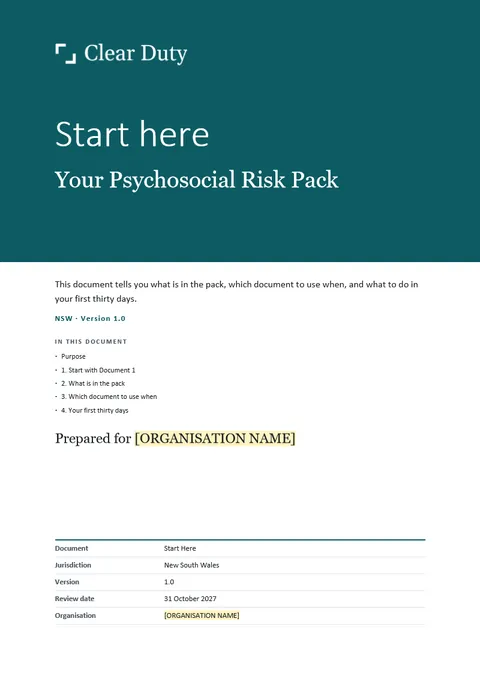
Start Here guide
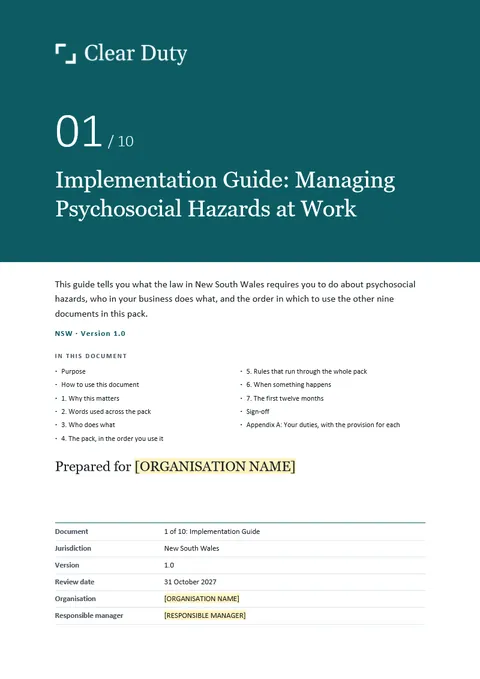
Document 1 Implementation Guide
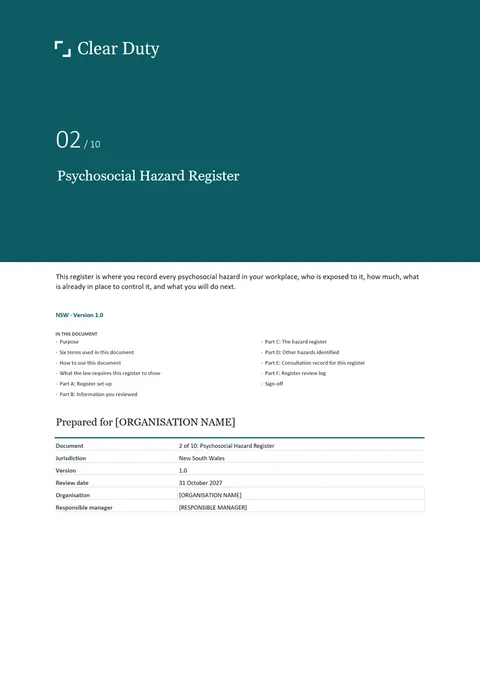
Document 2 Psychosocial Hazard Register
Document 3 Risk Assessment Method and Matrix
Document 4 Worker Consultation Pack
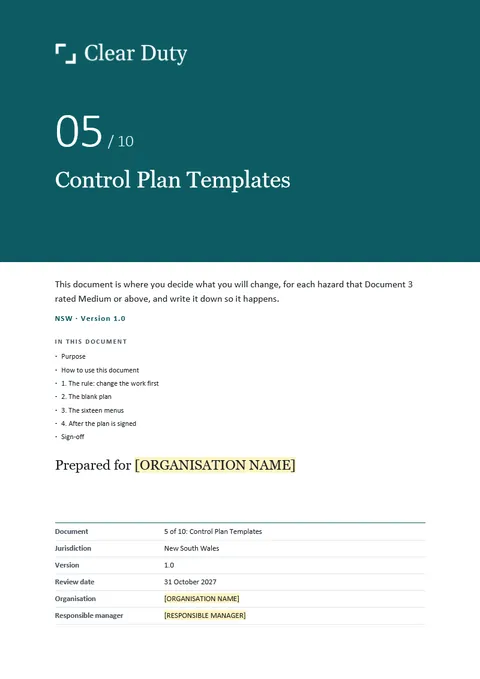
Document 5 Control Plan Templates
Document 6 Incident and Near-Miss Procedure
Document 7 Review and Revision Schedule
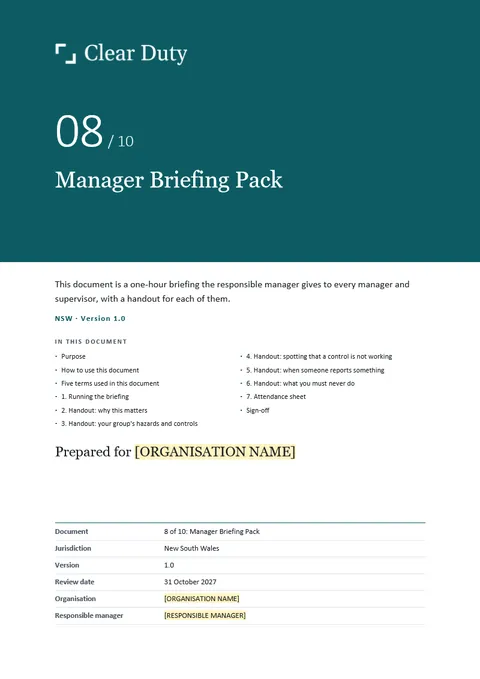
Document 8 Manager Briefing Pack
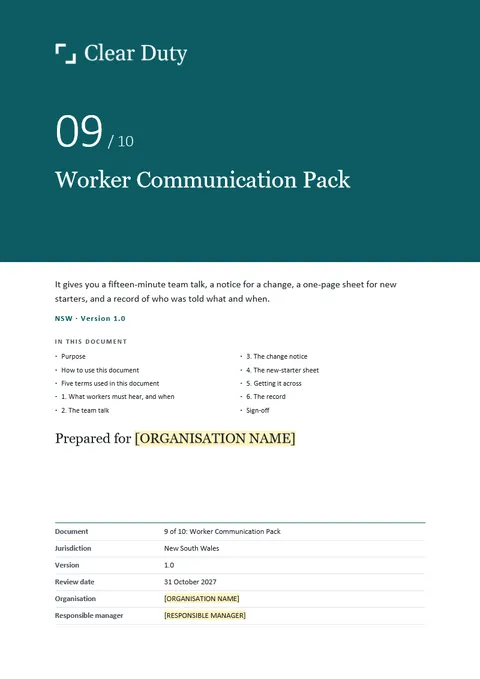
Document 9 Worker Communication Pack
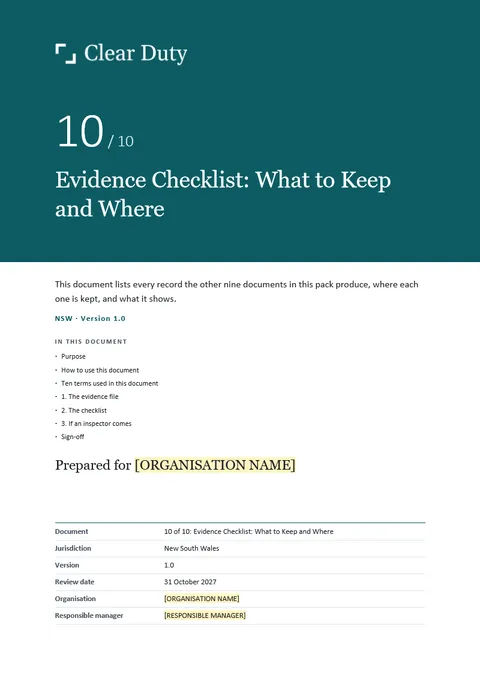
Document 10 Evidence Checklist
Launching soon. Join the launch list
What the law expects
Psychosocial hazards are covered by the Work Health and Safety Regulation 2025 (NSW), Part 3.2 Division 11.
Source: Work Health and Safety Regulation 2025 (NSW), Part 3.2 Division 11.
In NSW, the Regulation applies the hierarchy of control to psychosocial risks: where it is reasonably practicable, change the work itself before relying on training or procedures.
Source: Work Health and Safety Regulation 2025 (NSW), ss 55C(a) and 36.
Our reading of the Work Health and Safety Regulation 2025 (NSW), s 55D, is that an employee assistance program or wellbeing policy on its own is not a control of a psychosocial hazard.
Who this is for
- NSW businesses with about 10 to 60 people, including casuals.
- Owners and operations managers without a safety manager.
- Anyone whose main answer so far has been an EAP or a wellbeing policy, and who wants to check what else is needed.
Start with the free check
Eighteen questions, about four minutes. See your three biggest gaps and what to do about each one this week.